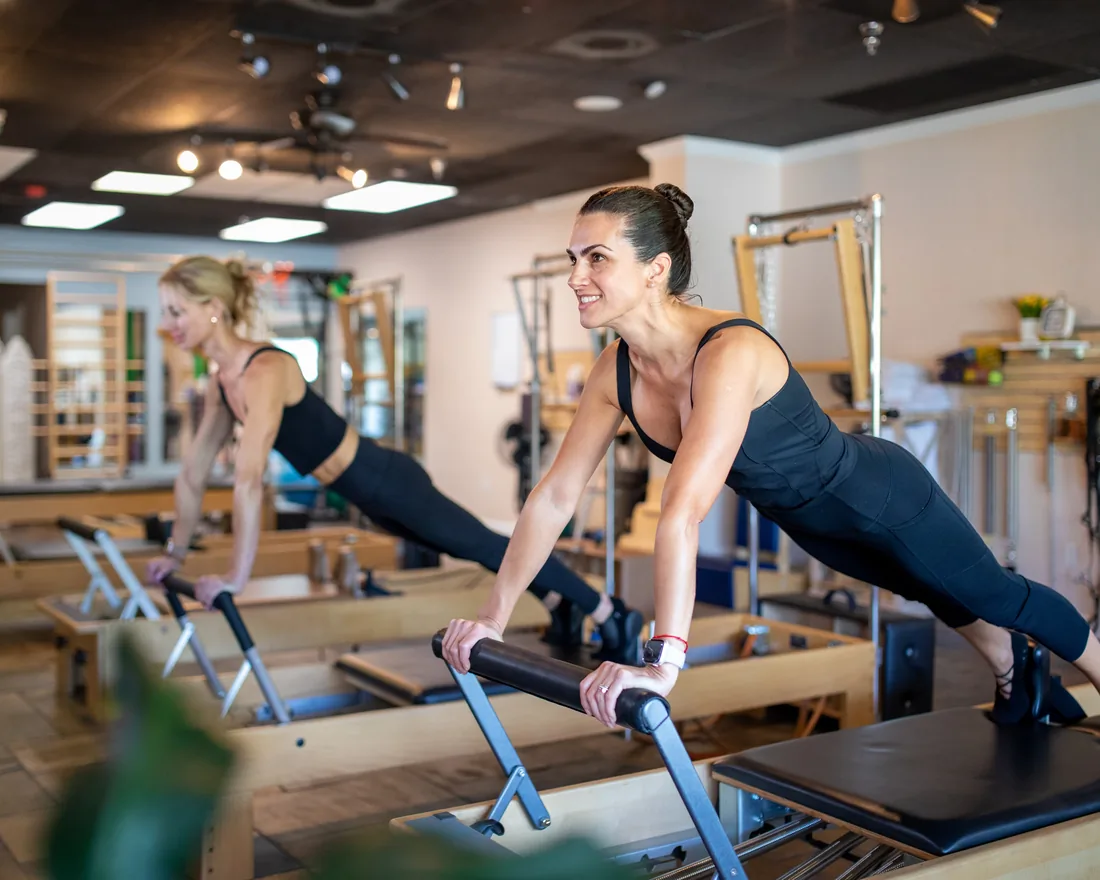
One of the most common questions new clients ask is which kind of session they should book. Paradise Pilates offers private sessions, duet sessions for two, and small-group classes, and the honest answer is that they are built for different things. Picking the right one has less to do with budget than with where you are starting from and what you want out of the work.
A private session is one instructor and one client for the full hour. Nothing is shared and nothing is generalized. The instructor watches how you move, asks about your history, and adjusts the work in real time. If something is not landing, it changes on the spot. That responsiveness is the entire point, and it is why private work is the recommended starting place for anyone new to Pilates or returning after a long gap.
Private sessions are also the right call if you are working around something specific: a shoulder that does not like overhead work, a back that flares up after long drives, a hip replacement that changed how you load one side. Those details are difficult to accommodate in a room with other people, and they are exactly what a private hour is designed to handle.
Duet sessions are semi-private, with two clients and one instructor. They work well for couples, friends, or family members who want to train together and keep each other accountable. The instructor still cues individually and still adjusts for each body, but attention is split, and the pacing has to work for both people.
That last point is worth being honest about. Duets go well when both clients are reasonably close in experience and working toward similar things. When one person is brand new and the other has years of reformer work behind them, the session tends to move at a compromise pace that fully serves neither. If you are considering a duet with someone at a very different level, a few private sessions first will make the shared work far more productive.
Small-group classes are the third format, and they serve a different purpose again. Classes have a planned structure, a set flow, and a social energy that private work does not have. There is still real instruction and there is still room for individual correction, but the class is not rebuilt around any one person. For clients who already know the fundamentals, classes are an efficient and enjoyable way to train consistently.
This is why the studio suggests at least one private session before joining classes. It is not an upsell. Reformer work involves springs, straps, a moving carriage, and specific alignment cues, and understanding those things in a focused setting means you spend class time training rather than decoding instructions. Clients who start with a private almost always get more out of every class that follows.
Most people do not stay in one format forever. A common pattern looks like this: a few privates to build a foundation, then classes for regular weekly training, with a private dropped in occasionally to work on something specific or reset technique that has drifted. Duets get added when a partner or visiting friend wants to join. The formats are meant to be mixed, not chosen once.
If you are still unsure, start with a private session and say so. Tell the instructor you are trying to figure out what fits. That conversation is a normal part of a first session, and it is far easier to answer once someone has actually watched you move.