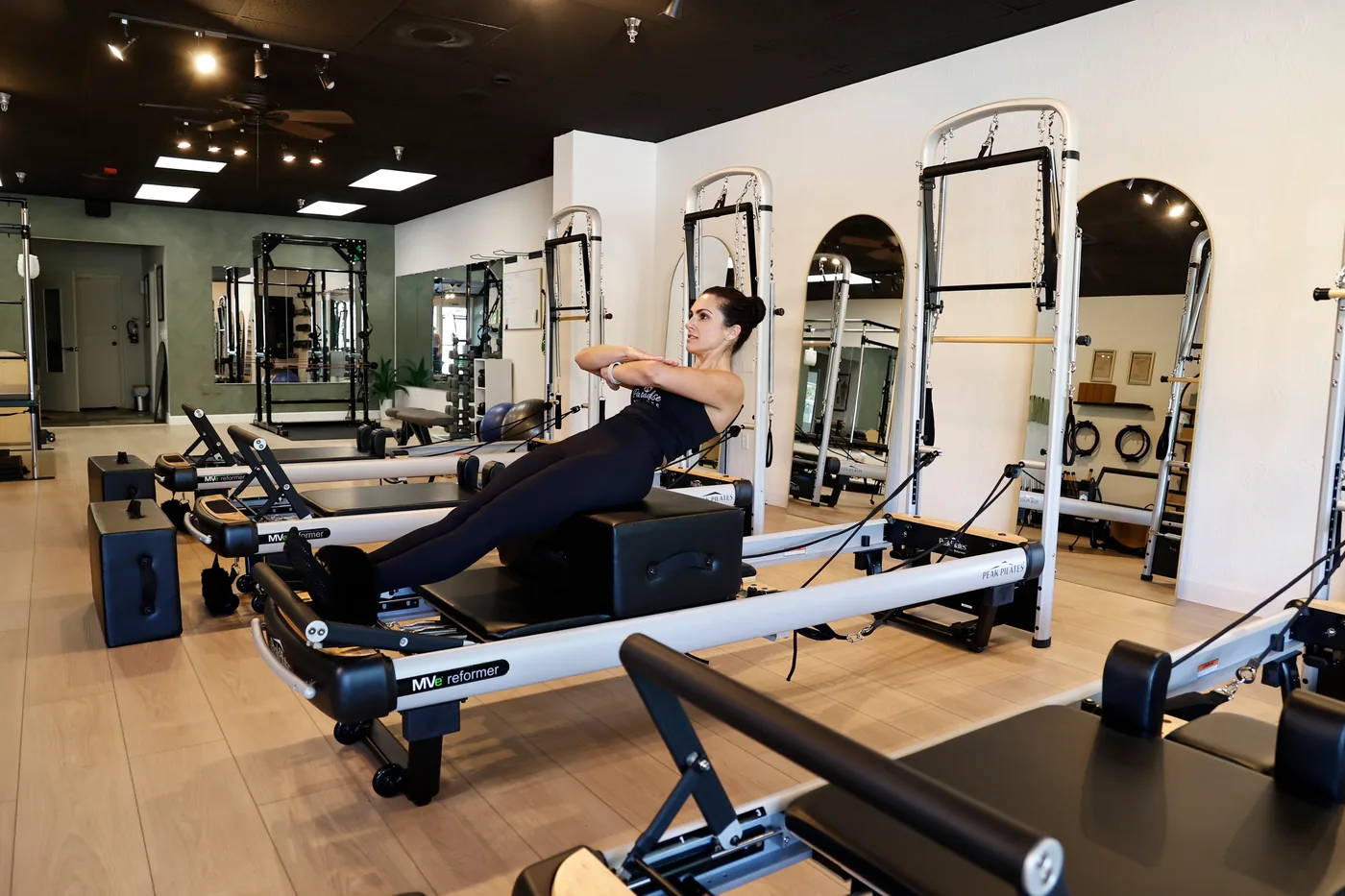
The short answer is that the exercises come from the same method and the same principles, but the mat gives you nothing to work against except your own body weight, while the reformer gives you a sliding carriage and a set of springs that can either help you or fight you. Neither one is the beginner version of the other. Most people who have never done Pilates find the reformer easier to understand on day one, because the machine shows them where to move and how far.
What a reformer actually is, in plain terms
A reformer is a low wooden or metal frame with a padded carriage that rolls back and forth on rails. At one end there is a footbar. At the other, a set of springs connects the carriage to the frame. Ropes and straps run over pulleys so you can push or pull the carriage with your feet, your hands, or both.
You can lie on it, sit on it, kneel on it, or stand beside it. Boxes and straps extend what it can do. The point of the whole contraption is that the carriage only travels in one line, so your body has to organize itself around that line. If your hip drops or your shoulder hikes, the carriage tells on you straight away by wobbling or stopping.
That is the real value of the machine. It is not a cardio device and it is not a weight stack. It is a feedback tool.
What the springs change: why a reformer can be both easier and harder than the mat
Springs do two different jobs depending on which way you are moving.
When you push the carriage away, the springs resist you. More springs, more resistance. That is the obvious direction, and it is how footwork, leg press and chest expansion build strength.
When you move with the spring, it assists you. A roll-up on the mat asks your abdominals to lift your whole trunk off the floor with no help at all, which a lot of people simply cannot do yet. The same movement on the reformer, with straps in your hands and a light spring, becomes achievable, and you can feel which muscles are supposed to be doing the work rather than just heaving yourself up with momentum.
So the reformer is easier in the sense that it meets you where you are. It is harder in the sense that it will not let you cheat. The carriage is unstable by design. Kneeling on a moving carriage and pressing into a strap asks more of your balance and your deep trunk muscles than the same shape on solid ground.
There is also a load question. Heavier springs are not always harder. On many exercises a lighter spring is the more difficult setting, because there is less support holding you in position. A good instructor changes springs between exercises for exactly this reason, and it is one of the things that confuses people watching a class for the first time.
What mat work still does better
Mat Pilates removes the machine, so nothing holds you in alignment and nothing helps you through the sticky part of a movement. That is useful.
Mat work builds the kind of control you actually use walking across a parking lot, getting up off the floor, or carrying groceries up the stairs. It teaches you to stabilize your own spine without a carriage underneath it. The classic mat sequence also flows, so you learn to link movements and keep breathing rather than stopping to change springs.
And it travels. Once you know a dozen mat exercises properly, you can do them in a condo living room, on a lanai, or in a hotel room when you are away for a few weeks. That matters here, where plenty of people split the year between Longboat Key and somewhere north.
In practice, most people who stick with Pilates do both. The reformer teaches the pattern, the mat proves you own it.
Which to start with if you have never done either
If you are deciding what to book first, start with whichever one you will be taught properly in, rather than worrying about the equipment.
That said, a few honest guidelines. If you have a specific issue, a shoulder that does not like overhead work, a replaced hip, back pain that comes and goes, the reformer is usually the better starting point because the springs let the work be scaled down without losing the shape of the exercise. If your main goal is general conditioning and you move well already, mat work will get you to a demanding level quickly.
You do not need to have done mat Pilates before stepping onto a reformer. That is a common assumption and it is not true. You also do not graduate from the reformer to the mat. They are two tools for the same work.
What a first reformer class on Longboat Key looks like, start to finish
Come in a little early. Fitted clothing is better than loose, because the instructor needs to see your hips and ribs, and loose shorts on a carriage are a nuisance. Socks are required, ideally with grips, and the studio sells Pilates socks if you need a pair. Bring water. In summer, it is worth arriving with a few minutes to cool off before you lie down.
The instructor will set your footbar height and headrest, then show you where the straps and the spring handles are. Most sessions open with footwork lying on your back, pressing the carriage away and letting it come back under control. It feels gentle and it is where the instructor reads your alignment.
From there you will usually work through some abdominal and arm work in the straps, something on your side, a bridging or hamstring sequence, and standing or kneeling work toward the end if it suits you. You will be asked to breathe out on the effort more often than feels natural at first.
You will not be sore the way you are after a heavy weights session, but you may feel muscles along your inner thighs, your upper back and the sides of your trunk that have been quiet for a while. That is normal and it settles after two or three sessions.
How to book, and why a private session first is recommended for beginners
If you are new to Pilates, we highly recommend booking a private session before joining a group class. There are a lot of small details on a reformer, spring settings, strap length, headrest position, and sorting them out one to one means your first class is spent moving rather than catching up. It also gives us a chance to hear about any injuries or surgeries before you are on the equipment.
If you are not sure which format suits you, our notes on private, duet, and group sessions go through the differences.
When you are ready, have a look at the weekly class schedule or get in touch with the studio and we will help you pick the right starting point.
Frequently asked questions
Do I need to do mat Pilates before trying a reformer class?
No. The reformer is not an advanced version of the mat, and plenty of people begin on the equipment. The springs make it easier to find the correct muscles, which is why beginners often understand the work faster on a reformer than on the floor.
Is reformer Pilates harder than mat Pilates?
It depends on the exercise. The springs can assist you through movements that would be very difficult on the mat, and they can also add resistance that makes an exercise much harder. On some exercises a lighter spring is the tougher setting because there is less support holding you in place.
What should I wear to a reformer session?
Fitted clothing so the instructor can see how your hips and ribs are moving, and socks, ideally with grips. The studio sells Pilates socks if you need a pair. Loose shorts and baggy tops tend to catch on the carriage and straps. Bring water.
Will reformer Pilates make me sore?
Usually not in the way heavy weight training does. Most people notice muscles along the inner thighs, upper back and sides of the trunk the next day, which eases after the first two or three sessions as those muscles get used to working.
Can I do reformer Pilates with an old injury or after surgery?
Often yes, and the springs are one reason why, because they let an exercise be scaled down without losing its shape. Tell the instructor about the injury or surgery before you start so the session can be built around it, and start with a private session rather than a group class.